Norway, Germany sign ‘Hansa Arrangement’ to strengthen bilateral defence cooperation
 13 oC
13 oC 
Güneşli

Norway and Germany have formalised a sweeping new defence partnership, known as the Hansa Arrangement, in a move both governments describe as a decisive step toward strengthening European security and reinforcing NATO’s collective defence posture.
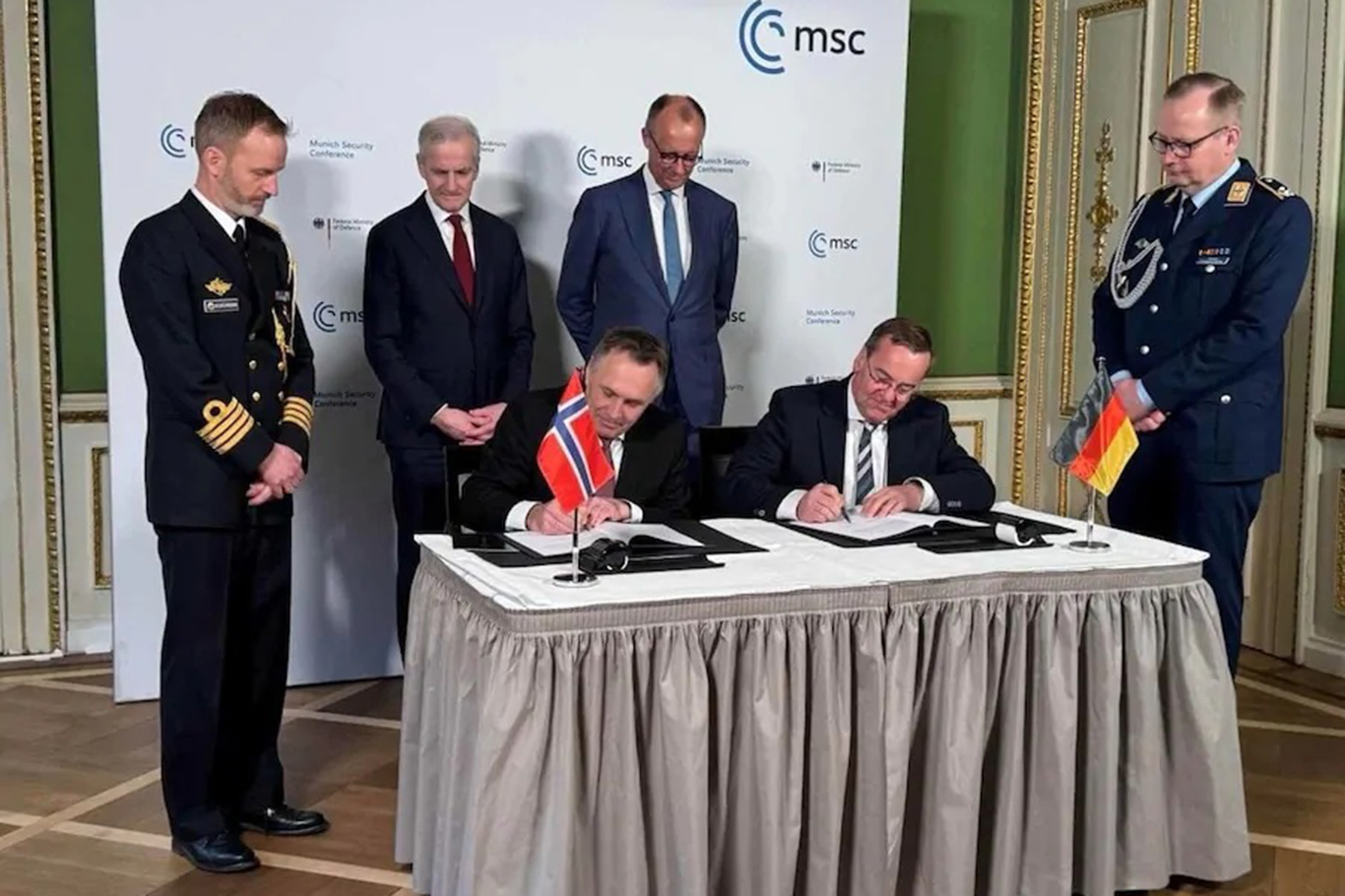
The agreement was signed by Norway’s Defence Minister Tore O. Sandvik and Germany’s Defence Minister Boris Pistorius on the sidelines of the Munich Security Conference, building on a commitment announced last summer by Norwegian Prime Minister Jonas Gahr Støre and German Chancellor Friedrich Merz to deepen bilateral defence ties.
Speaking at the signing ceremony, Sandvik stressed that closer European cooperation has become indispensable amid growing instability across the continent. He said Europe must shoulder a greater share of responsibility within NATO, describing Germany as one of Norway’s most important European allies and a key partner within the EU framework.
Five Pillars of Cooperation
The Hansa Arrangement establishes a broad framework for cooperation across all military domains, focusing on five core areas:
-Space-based surveillance, targeting and communications
-Maritime security and joint operations in the North Atlantic and North Sea
-Land warfare and combined arms capabilities
-Rapid reinforcement and host-nation support
-Defence industry collaboration
The pact formalises and expands an already robust defence relationship, particularly in maritime and industrial cooperation.
Submarines and Maritime Power
A central element of the partnership is joint submarine capability. Norway’s parliament recently approved the purchase of two additional submarines, bringing its total future fleet to six. Germany will also operate six identical submarines, enabling close operational integration.
Both countries are investing heavily in maintenance infrastructure, including new facilities at Haakonsvern naval base in Bergen, which will serve as a key hub for submarine support. The submarines are regarded as critical to NATO’s ability to monitor and secure the North Atlantic and the High North — regions of growing strategic importance.
In addition, Oslo and Berlin are jointly developing next-generation long-range maritime strike capabilities, including the 3SM missile system.
Germany is also expanding and modernising its navy, with plans to increase its operational footprint in the North Atlantic. Norwegian officials have welcomed this as a positive development for regional and allied security.
Allied Reinforcement and Land Forces
German forces regularly conduct training exercises in Norway, including participation in the upcoming Cold Response 26 winter drills. Norwegian officials emphasise that training in Arctic and winter conditions significantly enhances NATO’s operational readiness.
Oslo is also expanding its infrastructure to facilitate rapid allied reinforcement. Discussions are ongoing about the potential pre-positioning of German equipment in Norway to ensure faster deployment during crises.
On land, Norway’s procurement of German-made Leopard 2A8 main battle tanks further strengthens bilateral cooperation. Norwegian company RITEK will assemble a significant portion of the tanks domestically, reinforcing industrial ties and boosting local employment.
Norwegian and German troops also serve together in the German-led NATO multinational brigade in Lithuania as part of the alliance’s enhanced forward presence along its eastern flank.
Industrial and Space Collaboration
Beyond conventional military capabilities, the agreement highlights growing cooperation in defence industry and space technology. Norway was among Europe’s largest defence importers last year, purchasing equipment valued at approximately €1.4 billion — a move that has supported domestic industry and deepened industrial integration with German firms.
Space capabilities are also becoming increasingly central to defence planning. Norwegian officials pointed to Andøya Spaceport as a key strategic asset with potential to support German launch activities and broader European space cooperation.
A Strategic Signal
The Hansa Arrangement reflects a broader shift in European security policy, as countries seek deeper bilateral and regional partnerships while reinforcing NATO’s collective framework. Officials from both sides described the agreement as a long-term strategic investment in stability, interoperability, and deterrence at a time of heightened geopolitical uncertainty across Europe. (ILKHA)
LEGAL WARNING: All rights of the published news, photos and videos are reserved by İlke Haber Ajansı Basın Yayın San. Trade A.Ş. Under no circumstances can all or part of the news, photos and videos be used without a written contract or subscription.
Ukrainian President Volodymyr Zelenskyy delivered a forceful address at the Munich Security Conference, calling for stronger security guarantees for Ukraine and Europe as the war with Russia enters its fourth year.
Türkiye’s Foreign Minister Hakan Fidan met with Ali Shaath, head of the National Committee for the Administration of Gaza (NCAG), Turkish diplomatic sources said, as efforts continue to stabilize and rebuild the war-torn enclave following the October ceasefire.
Switzerland announced Saturday that talks between the United States and Iran are set to resume next week in Geneva, as Washington continues efforts to reach an agreement with Tehran that would, among other objectives, limit Iran’s nuclear program.