Bangladesh's former PM Hasina sentenced to 10 more years in jail

 13 oC
13 oC 
Güneşli

A court in Bangladesh has sentenced former prime minister Sheikh Hasina to 10 years in prison for abusing her authority by allocating state-owned land to members of her family, according to the state-run news agency BSS.
A special court convicted Hasina on corruption-related charges, sentencing her to 10 years in prison. Several members of her family were also given heavy penalties under similar accusations. With this latest ruling, Hasina’s total prison sentences now exceed several decades, according to court records.
Authoritarian rule and secular policies under scrutiny
Sheikh Hasina governed Bangladesh from 2009 to 2024, a period marked by what critics describe as one-man rule, systematic suppression of political opponents, and sustained pressure on Islamic circles. Religious groups and opposition figures accused her administration of interfering with madrasas, marginalizing devout communities, and institutionalizing a hardline secularism seen as antagonistic to Islam.
Human rights organizations and domestic critics have also linked her tenure to allegations of widespread corruption and crimes against humanity, charges that form the basis of multiple ongoing cases.
Controversial ties with India
Hasina’s close relationship with India, particularly with Prime Minister Narendra Modi’s Hindu nationalist government, has remained a central point of contention in Bangladeshi politics. Opponents argued that her foreign policy amounted to excessive dependence on New Delhi, claiming that Bangladesh’s sovereignty was compromised in favor of India’s regional interests.
According to critics, while Hasina pursued repressive policies at home, she aligned Bangladesh’s strategic posture closely with India abroad, fueling public resentment.
Exile in India after popular uprising
Following mass protests and student-led demonstrations in 2024, Hasina was forced out of power and fled to India, where she has since lived in exile. Despite repeated arrest warrants issued by Bangladeshi courts, Indian authorities have so far declined to act on the requests.
Judicial decisions against Hasina are widely interpreted as symbolic of the collapse of the political and economic order established during her rule. The interim administration and segments of the public argue that Bangladesh must be freed from what they describe as an Islam-hostile elite structure and externally dependent governance model.
For many in Bangladesh, the Sheikh Hasina cases have come to represent a broader historical reckoning—illustrating how power, ideology, and foreign reliance can ultimately lead to severe political and legal consequences.(ILKHA)
LEGAL WARNING: All rights of the published news, photos and videos are reserved by İlke Haber Ajansı Basın Yayın San. Trade A.Ş. Under no circumstances can all or part of the news, photos and videos be used without a written contract or subscription.

Russian forces launched a renewed wave of missile and drone attacks across Ukraine over the past 24 hours, killing at least six people — including a mother and her young child in the northeastern city of Kharkiv — and injuring at least 36 others, Ukrainian officials said on Sunday.

At least seven people were killed and six others injured after a minibus carrying workers collided with a truck on a highway in northwestern Egypt, local authorities said.
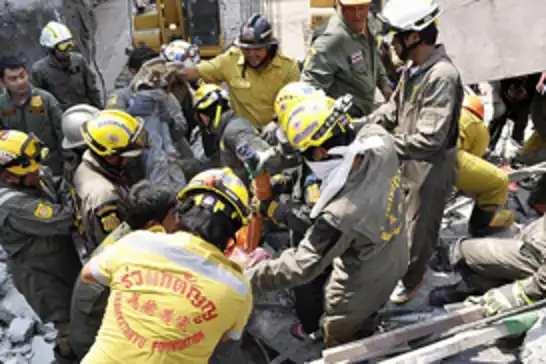
A building under construction collapsed in Thailand’s Samut Prakan province, leaving four workers injured, local authorities said.

At least 30 people were killed and several others injured in a devastating road accident in Kano State, northern Nigeria, local authorities confirmed on Monday.