Interstellar comet 3I/ATLAS makes closest approach to Earth
 13 oC
13 oC 
Güneşli

The interstellar comet known as 3I/ATLAS is making its closest approach to Earth this week, drawing intense interest from astronomers worldwide and captivating the public with its rare origin beyond the solar system.
According to astronomers, 3I/ATLAS will pass within approximately 270 million kilometers of Earth on December 19, 2025—close in astronomical terms, though posing no threat to the planet. The object is only the third confirmed interstellar visitor ever detected passing through the solar system, following ʻOumuamua in 2017 and 2I/Borisov in 2019.
Recent spectroscopic observations have revealed striking and atypical features. Scientists have detected unusually high levels of nickel and iron in the comet’s coma, a composition that differs from most known solar-system comets, which are typically dominated by water ice, carbon compounds, and dust.
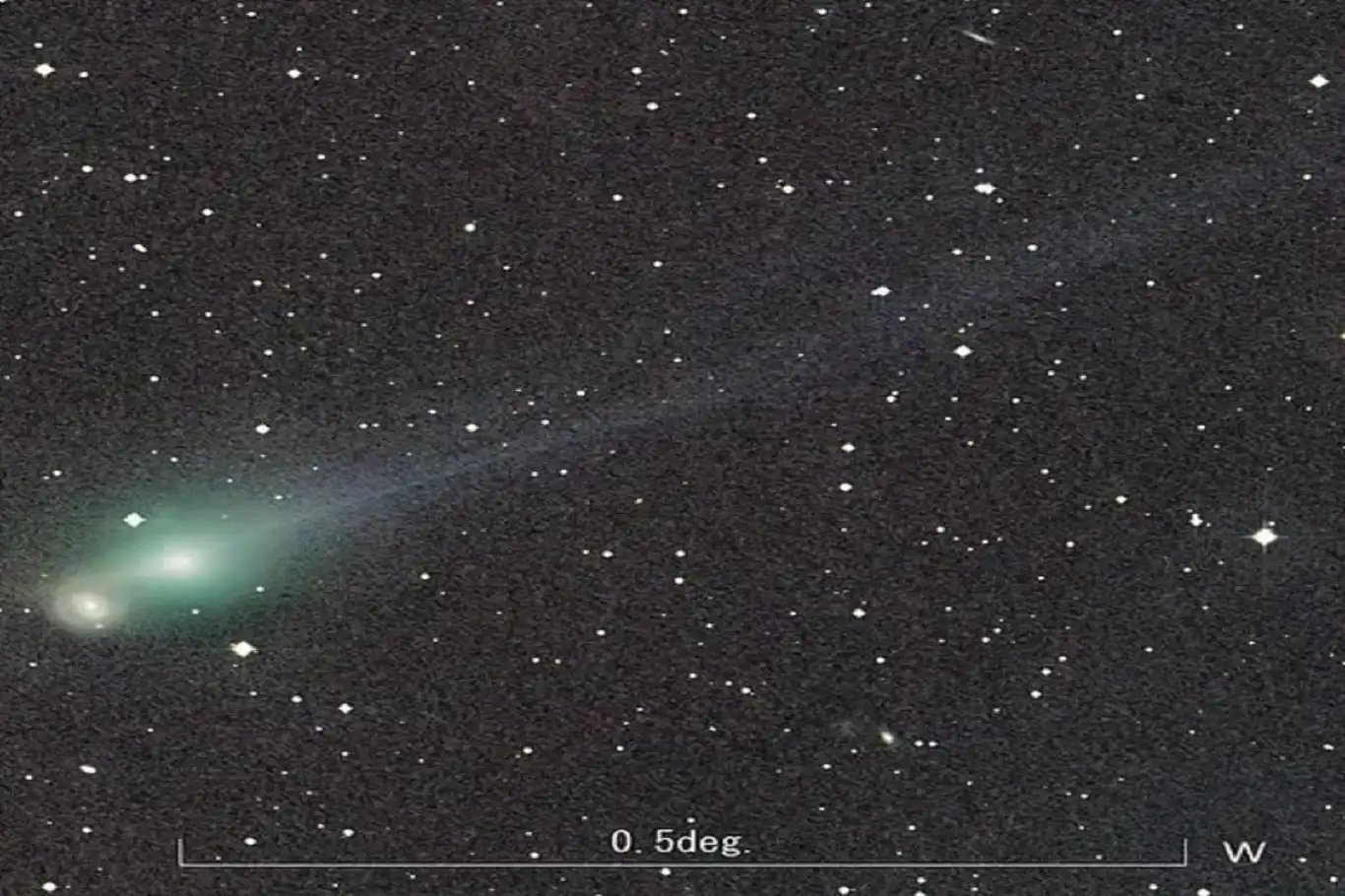
The comet has also exhibited a faint greenish glow, believed to be caused by excited diatomic carbon and possibly metal-rich compounds interacting with solar radiation. Researchers say the intensity and persistence of this coloration are uncommon and may offer clues about the chemical environment in which the comet originally formed.
“These chemical signatures suggest 3I/ATLAS formed around a very different type of star, or under conditions not commonly seen in our own solar system,” one research team involved in the observations said.
Since its discovery earlier this year by the ATLAS (Asteroid Terrestrial-impact Last Alert System) survey, observatories across the globe—including space-based telescopes—have been tracking the comet’s trajectory, rotation, and activity. Updated measurements confirm that 3I/ATLAS is moving at an extremely high velocity relative to the Sun, reinforcing its interstellar origin.
Astronomers have also noted fluctuations in the comet’s brightness over the past several weeks, suggesting intermittent outgassing as it warms during its passage through the inner solar system. However, unlike many comets, 3I/ATLAS shows no large, dramatic tail, further distinguishing it from typical solar-system objects.
Researchers emphasize that interstellar objects like 3I/ATLAS provide a rare opportunity to directly study material from beyond the Sun’s planetary system.
“Each interstellar visitor is effectively a sample of another star system,” scientists say. “They allow us to test theories about how planetary systems form and evolve across the galaxy.”
Preliminary modeling suggests the comet may have traveled for millions, possibly billions, of years through interstellar space before its chance encounter with the Sun.
After its closest approach to Earth, 3I/ATLAS will continue past the Sun and is expected to exit the solar system in early 2026, never to return. Astronomers plan to continue observations for as long as possible, using the data to refine models of interstellar chemistry and comet formation.
While some online speculation has dubbed the object an “alien comet,” scientists stress that the term refers only to its extrasolar origin and not to any evidence of artificial or intelligent design.
Even so, researchers say 3I/ATLAS represents one of the most intriguing astronomical visitors of the decade—an ancient traveler briefly illuminating humanity’s place in a much larger cosmic neighborhood. (ILKHA)
LEGAL WARNING: All rights of the published news, photos and videos are reserved by İlke Haber Ajansı Basın Yayın San. Trade A.Ş. Under no circumstances can all or part of the news, photos and videos be used without a written contract or subscription.

Turkish President Recep Tayyip Erdogan has received family members and relatives of six-year-old Palestinian girl Hind Rajab at the Presidential Complex in Ankara, offering condolences and reaffirming Türkiye’s support for the Palestinian people amid Israel’s ongoing assault on Gaza.

Türkiye’s Minister of Interior Ali Yerlikaya has highlighted the Disaster and Emergency Management Presidency’s (AFAD) expanding global role as the agency marks the 16th anniversary of its establishment.

As his party approaches its 13th anniversary, HÜDA PAR (Free Cause Party) Secretary General Hüseyin Yılmaz declared that Türkiye’s enduring crises prove the nation needs his party’s platform now more than ever.