Ukraine strikes Crimean Bridge for third time this week
 13 oC

Güneşli

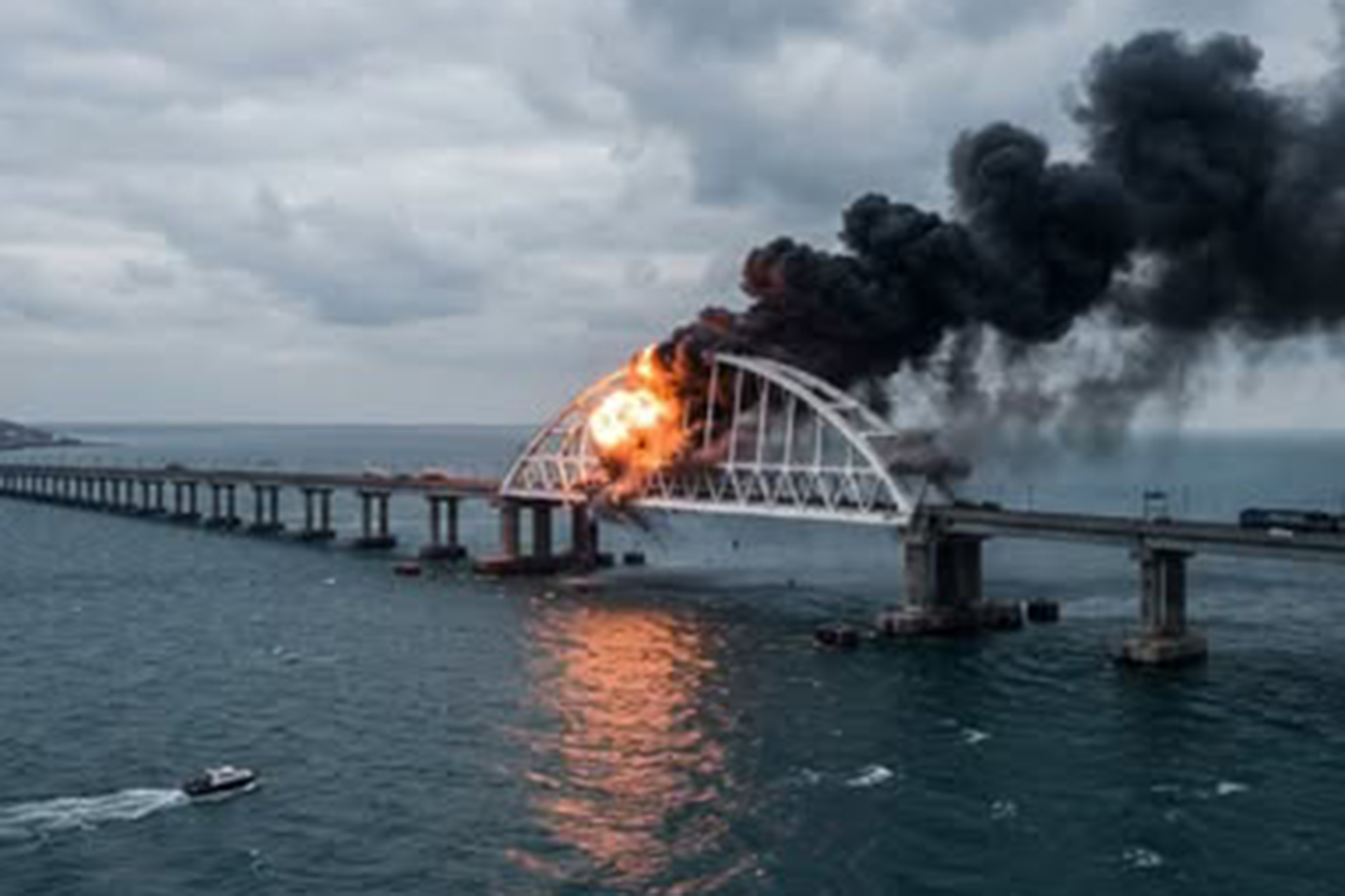
Ukrainian forces struck the Crimean Bridge with domestically produced Neptune missiles overnight on Thursday, damaging its railway section and bringing train traffic to a halt, Ukraine's Defense Ministry confirmed.
The latest attack came less than two days after a separate Ukrainian missile and drone operation caused a major section of the strategic crossing to collapse into the Kerch Strait, further disrupting a key transport link between Russia and occupied Crimea.
"Hits have been confirmed near the arch and the railway tracks. The extent of the damage is currently being assessed, but for now, all train traffic has been halted," the Ukrainian Defense Ministry said in a statement.
Ukraine's Defense Ministry said the November 19 operation involved more than 16 strikes using multiple weapons systems and technologies, including Flamingo and Neptune missiles, according to Fire Point, the Ukrainian defense company that manufactures the Flamingo cruise missile.
The Ukrainian General Staff also confirmed that Neptune coastal defense missile systems operated by the Ukrainian Navy had struck the bridge, describing it as a major supply route used by Russian forces to transport fuel, ammunition and military equipment to occupied southern Ukraine.
The ministry described the crossing as a "war conveyor belt" for Russian forces, arguing that its disruption would force Moscow to rely on alternative overland routes closer to the front lines, where Ukrainian drones could target military shipments.
"The conveyor belt has now broken down. The alternative route runs overland, along the front line — where our drones are waiting to greet the cargo," the ministry said.
In another message directed at Russian forces, it added: "Final stop. Please vacate Crimea."
Third attack in a week disrupts strategic crossing
The November 19 strike marked the third attack on the Crimean Bridge within a week.
During an earlier operation overnight on November 16-17, Ukrainian forces struck the crossing with a combination of missiles and drones, causing a 227-meter section of the road bridge and one of its supporting arches to collapse into the Kerch Strait.
Ukrainian President Volodymyr Zelenskyy described the operation as the culmination of a seven-stage campaign prepared over several weeks. The operation involved domestically developed Flamingo cruise missiles, Neptune missiles and several types of Ukrainian drones.
The road section was severely damaged, while the railway connection was also affected. Although train services resumed after the initial attack, the latest Neptune missile strikes again disrupted railway traffic.
Russia's Transportation Ministry confirmed the temporary suspension of train services following the November 19 attack, adding that no casualties had been reported and specialists were assessing the damage.
Sergey Aksyonov, the Russian-installed head of Crimea, also confirmed the latest strike. He later announced that railway services were expected to resume at around 4 p.m. local time after emergency repair crews worked to restore the tracks.
Putin threatens retaliation as bridge attacks escalate
Russian President Vladimir Putin vowed a strong response to the attacks, warning that Moscow's retaliation would be more damaging than the Ukrainian strikes.
Speaking at a news conference in China's Shenzhen following a meeting with US President Donald Trump and Chinese President Xi Jinping, Putin said Russia would respond to the destruction of the bridge.
"Our response will be far more painful than Kyiv's attack on the bridge," he warned.
Putin also insisted that the crossing was used by civilians and said Russia would rebuild the damaged road section. He added that the railway section had already been repaired.
The attacks came as Putin was in China for high-level meetings with Trump and Xi, adding diplomatic significance to the timing of the operation.
Russia arranges alternative transport across Kerch Strait
With the road section of the bridge severely damaged and railway services temporarily disrupted, Russian-installed authorities in Crimea announced plans to introduce passenger ferry services across the Kerch Strait.
The ferries are expected to operate between the ports of Krym and Kavkaz, with the first crossings scheduled for November 20. The service will offer passengers a free alternative to the damaged bridge.
Oleg Kryuchkov, an adviser to Crimea's Russian-installed administration, said the ferry operations would depend on weather conditions, warning that storms could lead to several suspensions each week. Passengers will also be prohibited from carrying gasoline canisters aboard the vessels.
The alternative service highlights the difficulties facing Russian authorities in maintaining transport links between the peninsula and mainland Russia following the repeated attacks.
A major logistical and symbolic target
Built by Russia following its occupation and illegal annexation of Crimea in 2014, the Crimean Bridge, also known as the Kerch Bridge, connects Russia's Krasnodar region with the occupied peninsula across the Kerch Strait.
Stretching approximately 19 kilometers (12 miles), it is the longest bridge in Europe and serves both civilian transport and Russian military logistics.
Beyond its strategic importance, the crossing has become a powerful symbol of Moscow's control over Crimea and one of the most prominent infrastructure projects associated with Putin.
Ukraine has repeatedly targeted the bridge since the beginning of Russia's full-scale invasion in February 2022. A truck bomb caused significant damage in October 2022, while Ukrainian naval drones struck its supports in July 2023. Both attacks disrupted traffic but did not permanently disable the crossing.
The latest operation appears to have caused more extensive damage than previous strikes, particularly to the road section. Ukrainian officials say the attacks are intended to weaken Russia's ability to supply its forces in occupied territories.
The bridge's disruption also comes amid wider Ukrainian efforts to target Russian military logistics infrastructure. Ukraine's General Staff has reported damage to three other road bridges used by Russian forces, including crossings in occupied Luhansk and Russia's Rostov region.
Meanwhile, Russia has vowed to restore the Crimean Bridge. However, the scale of the latest damage could make repairs a lengthy and costly undertaking. Experts cited by the Kyiv Independent have estimated that restoring the damaged structure could take a year or longer and require substantial resources.
For Ukraine, the repeated strikes represent an effort to undermine one of Russia's most important supply routes to occupied Crimea and southern Ukraine. For Moscow, restoring the crossing and maintaining alternative transport links remain critical challenges as the war continues. (ILKHA)
LEGAL WARNING: All rights of the published news, photos and videos are reserved by İlke Haber Ajansı Basın Yayın San. Trade A.Ş. Under no circumstances can all or part of the news, photos and videos be used without a written contract or subscription.

Hezbollah has strongly condemned the latest Israeli aggression against the Gaza Strip, denouncing threats and forced evacuation orders that are driving thousands of Palestinians from their homes amid continued bombardment and a worsening humanitarian crisis.

China, the United States and Russia have issued a joint "Declaration Toward Peace" following an unprecedented summit between their leaders in the Chinese city of Shenzhen, outlining commitments to United Nations reform, nuclear risk reduction, energy cooperation and restrictions on the jurisdiction of international legal institutions.

The European Commission has confirmed that one of its information technology systems was targeted in an artificial intelligence-assisted cyberattack, prompting the temporary suspension of several internal applications as a precaution while an investigation remains ongoing.