Over 1 million join nationwide strike across Italy over wages, public spending
 13 oC

Güneşli

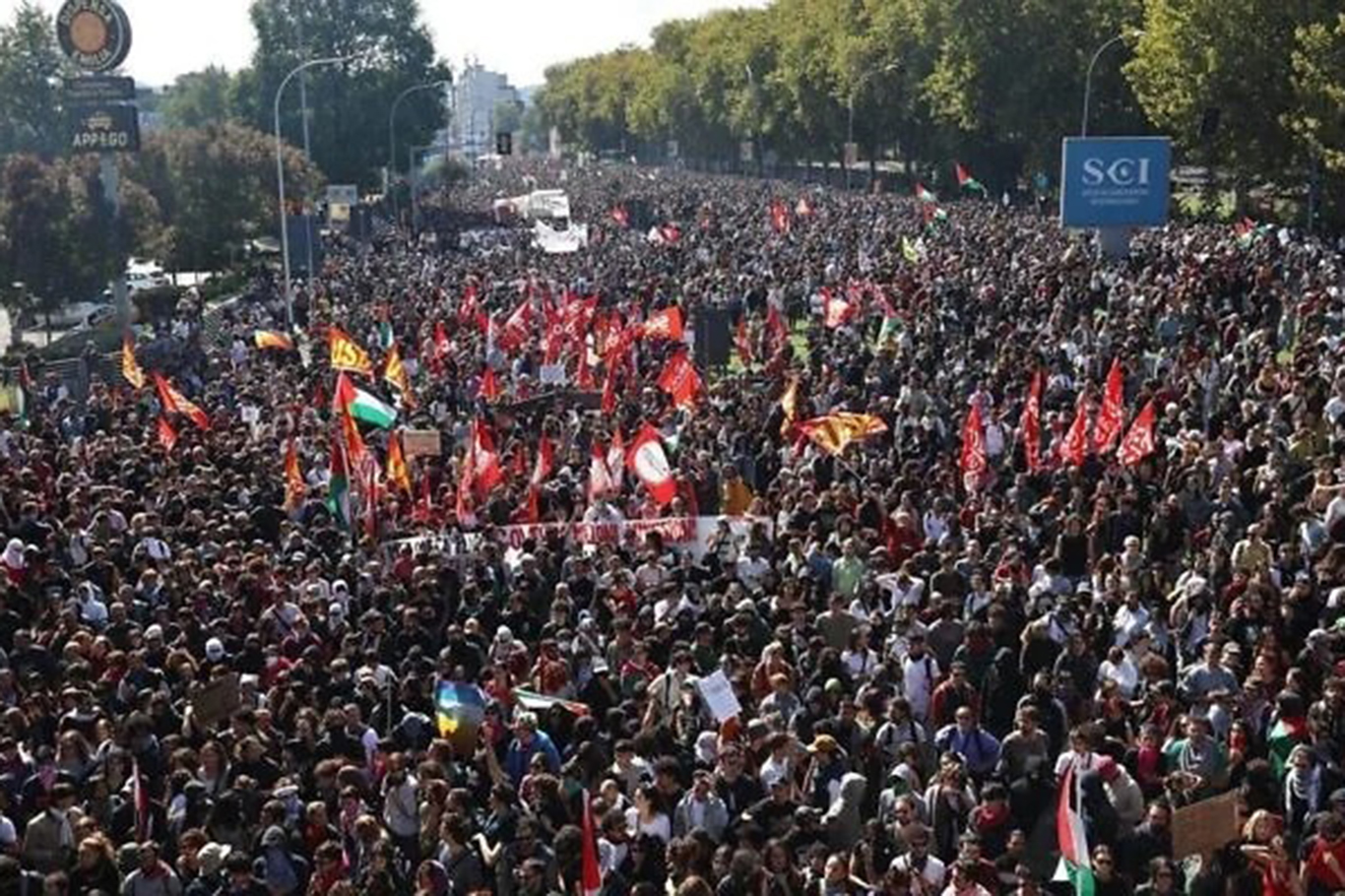
More than one million workers, students and pensioners took to the streets across Italy on Friday as the country's largest trade union, the General Confederation of Italian Labour (CGIL), staged a nationwide general strike against Prime Minister Giorgia Meloni's economic policies, demanding higher wages, stronger public services and greater investment in education and healthcare.
CGIL Secretary-General Maurizio Landini said approximately 1.5 million people participated in demonstrations across more than 100 cities and towns, adding that the average strike participation rate among public- and private-sector workers had reached 60%, according to preliminary union figures.
"We will not stop; we are the majority in this country," Landini said during a rally in Rome, where he led the CGIL-organized march.
The demonstrations took place in major cities, including Rome, Milan, Naples, Genoa, Bologna, Bari and Turin, with workers, students and pensioners joining marches organized by CGIL, grassroots unions such as Cobas and other labor organizations.
The 24-hour strike affected public and private sectors, including education, healthcare, local public transportation, ports and taxi services. Some schools, healthcare facilities and public transport services experienced disruptions.
Air and rail transport were excluded from the CGIL-led action following intervention by the country's strike guarantee commission. However, a separate railway strike called by other unions was scheduled to begin at 9 p.m. Friday and continue until 8 p.m. Saturday.
The Italian mobilization coincided with a broader wave of youth demonstrations across Europe, where students protested rising living costs, inadequate education funding, deteriorating public services and increased military spending.
According to reports, demonstrations took place in at least 25 European countries, with thousands gathering in German cities, London and other major urban centers.
Students demand investment in education, oppose militarization
Friday's demonstrations followed a nationwide mobilization on October 30, when thousands of students joined striking workers to demand greater investment in education and measures to address rising living and housing costs.
Student groups have continued protests and occupations at schools and universities, increasingly making opposition to higher military spending a central part of their demands.
"We are living under a government that, piece by piece, is cutting healthcare and education, taking away our present and trying to rob us of our future," said Laura Peritore, a 24-year-old university student.
"We are making it clear that we will not back down and will take our future back," she added.
Across Europe, young demonstrators have also raised concerns about economic insecurity, insufficient educational opportunities and proposals to increase military expenditure.
In Germany, thousands joined demonstrations in several cities, while students in other European countries called on governments to prioritize education, employment and social welfare over military investment.
CGIL criticizes Meloni government's €26 billion budget
The strike comes as Italy's parliament examines the government's proposed €26 billion ($30 billion) budget for 2027, which has drawn criticism from trade unions and opposition parties over what they describe as insufficient support for workers, young people and public services.
CGIL argues that the proposed spending package fails to adequately address declining purchasing power, rising living costs and the deterioration of essential public services.
The union is demanding substantial wage increases and the renewal of employment contracts to compensate for purchasing power lost to inflation. It is also calling for full inflation-based adjustments to pensions and measures to prevent an increase in the retirement age.
Industry Minister Adolfo Urso dismissed the timing of the strike as politically motivated, describing it as a "pre-emptive strike" because Landini had announced the action before the full contents of the budget were known.
Nevertheless, Urso said he respected those participating in demonstrations and lawmakers proposing amendments to the budget, adding that the legislation could be improved during parliamentary discussions.
Meanwhile, opposition Democratic Party leader Elly Schlein joined demonstrators in Rome, as the opposition seeks to capitalize on growing public dissatisfaction with the government's economic priorities.
Economic concerns mount ahead of 2027 election
Italy's economic difficulties and the rising cost of living have become increasingly important political issues ahead of the parliamentary election scheduled for 2027.
Inflation climbed to 5.5% in October, according to figures cited by the Financial Times, intensifying pressure on household budgets and adding to concerns about stagnant wages and economic inequality.
The government's proposed budget includes tax reductions and additional spending measures, but critics argue that its provisions do not go far enough to strengthen healthcare, education and social protection.
The debate has also exposed disagreements within the governing coalition over budget amendments and additional funding for healthcare and other public services.
Speaking during Friday's demonstrations, Landini said ordinary people were struggling to meet basic needs and demanded a fundamental change in government spending priorities.
"People have very basic problems: they struggle to make ends meet and therefore need higher wages; they need a healthcare system that works; young people need schools that work," he said.
"This budget does not address a single one of them."
Landini warned that the union would continue its mobilization if the government failed to respond to workers' demands, saying Friday's demonstrations reflected growing public calls for economic and social change. (ILKHA)
LEGAL WARNING: All rights of the published news, photos and videos are reserved by İlke Haber Ajansı Basın Yayın San. Trade A.Ş. Under no circumstances can all or part of the news, photos and videos be used without a written contract or subscription.
At least nine people were killed and dozens injured in a massive Russian missile and drone assault across Ukraine overnight on November 20, disrupting electricity, heating and water supplies and damaging critical infrastructure, including three bridges in the capital, Kyiv.

Russian Foreign Ministry spokesperson Maria Zakharova has accused NATO of fundamentally changing its military strategy and preparing for a possible armed confrontation with Russia within the next three to five years, warning that the alliance's evolving military doctrine could further escalate tensions.

A small aircraft crashed near a highway in Nuevo León state, Mexico, shortly after takeoff, narrowly avoiding a major disaster as it came close to hitting vehicles travelling on the road.