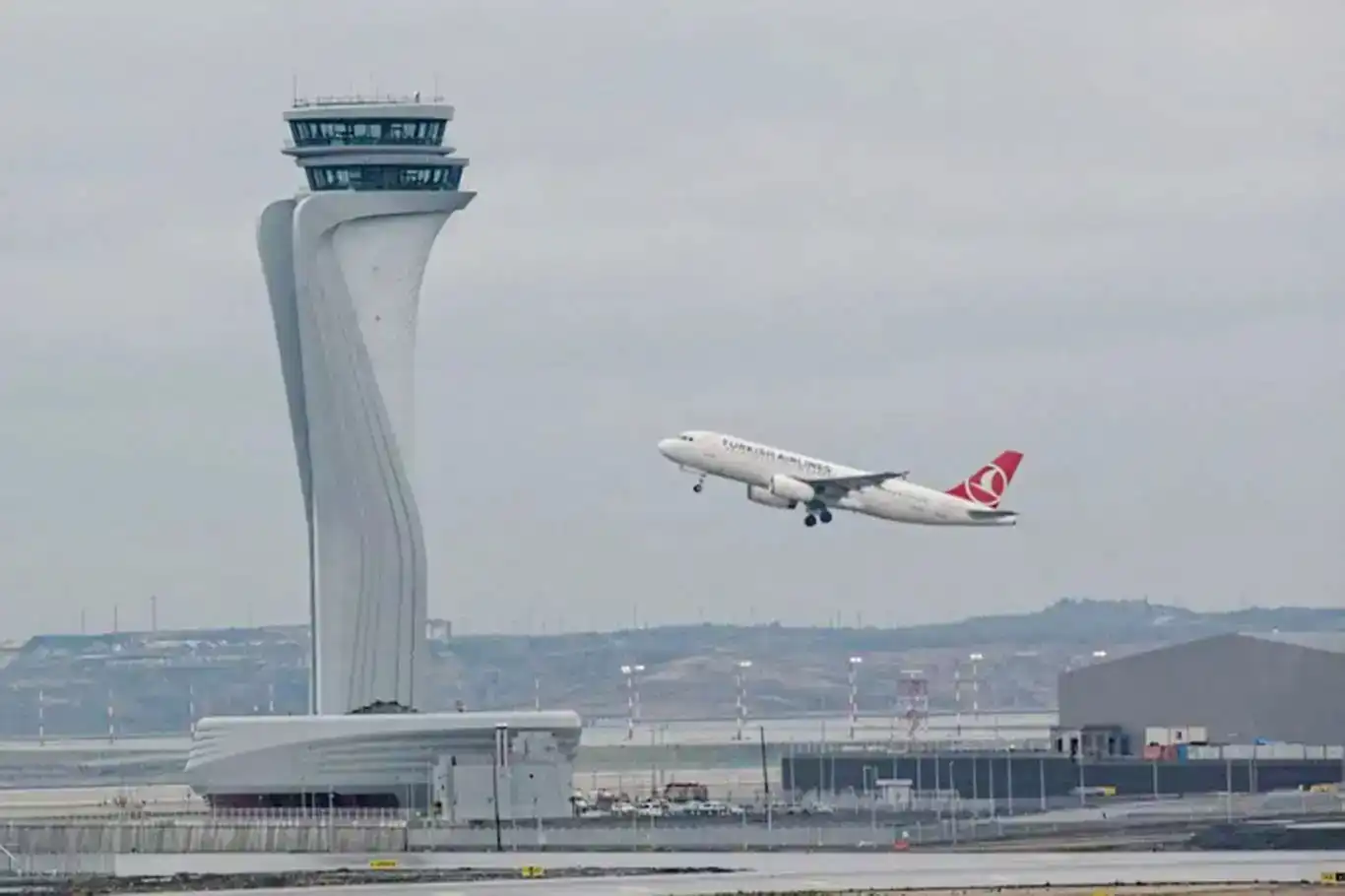
Istanbul Airport reclaims title as Europe's busiest air hub for third year running
 13 oC
13 oC 
Güneşli

In a testament to its robust recovery and strategic importance in European aviation, Istanbul Airport has once again topped the list as Europe's busiest air hub for the third consecutive year.
According to the latest Eurocontrol data released on Thursday, the airport managed an impressive average of 1,401 daily flights in 2024, marking a 2% increase from the previous year.
Amsterdam's Schiphol Airport secured the second spot with 1,336 daily flights, outpacing London Heathrow, which settled in third with 1,302 flights. Paris Charles de Gaulle and Frankfurt airports followed, handling 1,275 and 1,204 flights respectively each day.
Rome's Fiumicino Airport emerged as a standout, climbing to ninth place with an 18% surge in flight numbers compared to 2023, while both Barcelona and Rome returned to pre-pandemic traffic levels, with Barcelona notably achieving a new record of 1,173 flights on a single day in June.
The year 2024 saw European air traffic peak at 10.7 million flights, a 5% increase from 2023, yet still at 96% of 2019's pre-COVID levels. The recovery has been uneven, with Southern Europe surpassing pre-COVID numbers thanks to booming tourism and strategic route adjustments. However, Northern and Northeastern Europe faced challenges, with factors like airspace closures and decreased demand slowing their recovery.
The UK led the charge with the highest daily flight average at 5,488, up by 4% from the previous year, followed by Spain with 4,984 flights (an 8% increase), and Germany with 4,711 (up 4%). Italy showed remarkable growth, with a 9% rise in flights, primarily due to enhanced connections with key markets like Spain, Germany, and Poland.
Despite these gains, some nations like Germany and Switzerland have not fully recuperated, with Germany experiencing a 16% drop below 2019 levels due to shifts towards rail travel and reduced domestic demand. The closure of Ukrainian airspace since February 2022 and the conflict in Israel starting in October 2023 have also reshaped regional air traffic patterns, with Armenia experiencing similar effects due to geopolitical tensions.
Low-cost and mainline carriers have been at the forefront of the recovery, with increases of 8% and 7% respectively, together representing 70% of the traffic. Other segments like business aviation and regional services held steady, with slight downturns noted in cargo and military flights.
The year was not without its hurdles; air traffic management delays averaged 2.1 minutes per flight, attributed to increased traffic, airspace limitations, and weather disruptions. Staff shortages also played a role. On the positive side, lower jet fuel prices at $2.39 per gallon and a slight decrease in airfares provided some relief, though punctuality only improved to 72.5%, still underperforming compared to 2019.
Looking ahead, Eurocontrol predicts a complete recovery for European air traffic in 2025, potentially even exceeding 2019 levels in certain periods. The allure of Southern Mediterranean destinations is expected to continue, fueled by tourism from within Europe and beyond. (ILKHA)
LEGAL WARNING: All rights of the published news, photos and videos are reserved by İlke Haber Ajansı Basın Yayın San. Trade A.Ş. Under no circumstances can all or part of the news, photos and videos be used without a written contract or subscription.

Türkiye and Iraq have signed a one-year agreement to maintain the operation of the Iraq–Türkiye crude oil pipeline, ensuring the continued flow of Iraqi oil exports while both countries work toward a broader long-term energy partnership.

Türkiye's exports increased by 21.7% year-on-year in June 2026, reaching $24.9 billion, while imports climbed 23.0% to $35.3 billion, resulting in a wider foreign trade deficit, the Turkish Statistical Institute (TurkStat) and the Ministry of Trade said in a statement on Friday.

Türkiye’s total installed electricity capacity reached 126,113 megawatts (MW) as of the end of June 2026, with renewable energy sources accounting for 62.7% of the total, the Ministry of Energy and Natural Resources announced on Thursday.

Türkiye's seasonally adjusted unemployment rate declined to 7.6% in June 2026, marking a 0.5 percentage-point decrease from the previous month, while employment and labor force participation continued to improve, the Turkish Statistical Institute (TurkStat) said in a statement on Thursday.